
WHEN AI CREATES EVERYTHING, WHAT MAKE A BRAND DIFFERENT?
Introduction:-
Imagine a world where almost every brand can create a professional advertisement in seconds.
A few words can generate an image.
A simple idea can become a video.
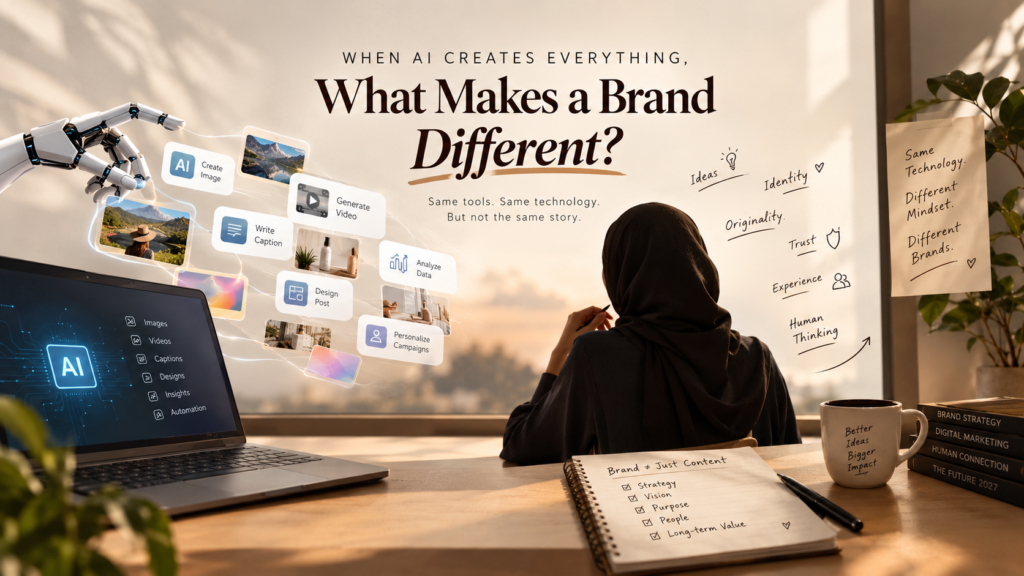
AI can write captions, create designs, analyze customers, suggest campaigns, and even personalize marketing messages.
This is the digital world we are moving toward in 2027.
AI is making content creation faster, easier, and more accessible than ever before. But this creates an interesting question:
If everyone has access to the same powerful technology, what will actually make one brand different from another?
The answer is not simply better technology.
It will be ideas, identity, originality, trust, experience, and the human thinking behind the technology.
AI can help a brand create more. But creating more does not automatically mean creating something meaningful. In a world filled with AI-generated content, the brands that stand out will be the ones that know what they want to say, why they want to say it, and who they want to connect with.
1. AI Can Create Content, But It Cannot Be Your Brand
AI can generate an impressive caption, image, video, or advertisement.
But a brand is more than its content.
A brand represents its personality, values, beliefs, promise, and the experience it gives people.
Two businesses can use the same AI tool and receive similar-looking results. What makes them different is the thinking behind the output.
For example, AI can write:
“Quality products made for you.”
But thousands of brands could say the same thing.
A strong brand knows what makes its version of that message meaningful.
The real competitive advantage will therefore move from content production to brand thinking.
2. Original Ideas Will Become More Valuable
When content becomes easier to produce, originality becomes more important.
Today, creating a social media post can take hours. In the future, AI may reduce that process to minutes or even seconds.
That sounds like a huge advantage.
But when everyone can produce ten posts a day, producing ten posts will no longer be impressive.
The question will become:
“What is different about your idea?”
Original perspectives, unique storytelling, strong opinions, creative campaigns, and memorable brand concepts can become more valuable than simply producing a large amount of content.
AI can help execute an idea.
Humans still need to decide which idea is worth executing.
3. Human Stories Will Become a Competitive Advantage
People do not connect with brands only because of products.
They connect with stories.
A founder explaining why a business was started, a customer sharing a genuine experience, a team showing the work behind a product, or a brand sharing a meaningful journey can create emotional connections.
AI can assist with storytelling, but genuine human experiences come from real people.
As AI-generated content becomes more common, audiences may increasingly value content that feels personal, relatable, and real.
This does not mean every brand needs to become emotional.
It means every brand needs to become human enough to be remembered.
4. Trust Will Matter More in an AI-Generated Internet
AI also creates a new challenge: people may find it harder to know what is real.
Images can be generated. Voices can be replicated. Videos can be created artificially. Reviews and comments can potentially be manipulated.
As technology becomes more powerful, credibility becomes more valuable.
Brands will need to be transparent about how they communicate, where information comes from, and what they promise.
A customer may forgive a brand for not being perfect.
But losing trust can be much harder to recover from.
In 2027, trust can become one of the strongest differences between brands competing in the same market.
5. Customer Experience Can’t Be Automated Completely
AI can answer questions.
AI can recommend products.
AI can personalize emails.
AI can automate customer support.
But customer experience is more than automation.
Imagine a customer has a serious problem with an order. They may not want another automated response. They may want someone who understands the situation and takes responsibility.
Technology can make customer journeys faster.
Human understanding can make them better.
The strongest brands will find the right balance between automation and human interaction.
6. Personalization Will Go Beyond “Hi, Your Name”
Personalization is becoming a major part of digital marketing.
But simply adding someone’s name to an email is not meaningful personalization.
Real personalization means understanding what a customer actually needs.
AI can analyze behaviour and help brands deliver more relevant recommendations, content, offers, and experiences.
But brands must also respect privacy and avoid making personalization feel intrusive.
The goal should be:
“This brand understands what I need.”
Not:
“This brand knows too much about me.”
That difference will matter greatly in the future.
7. Brand Experience Will Matter More Than Individual Posts
A brand is no longer judged by one advertisement.
People experience brands through multiple touchpoints:
- Google Search
- Websites
- Advertisements
- Reviews
- Online stores
- Customer service
- Emails
- Packaging
- Post-purchase support
If these experiences feel connected, the brand becomes stronger.
If the Instagram page looks premium but the website feels outdated, customers notice.
If advertising promises one thing but the actual product delivers another, customers notice.
AI can help optimize each touchpoint.
But strategy is needed to connect them all.
8. Creativity Will Shift From Making to Thinking
For a long time, creativity in marketing often meant creating something visually attractive.
AI is changing that.
When beautiful designs, videos, captions, and concepts can be generated quickly, creativity will increasingly mean:
What should we create?
Why should we create it?
Who is it for?
What should people feel or do after seeing it?
This makes strategic thinking more important.
The future creative marketer will not simply be someone who knows how to use tools.
It will be someone who knows how to think differently with those tools.
9. Brands Need a Point of View
In a world filled with content, being neutral and generic can make a brand forgettable.
A strong brand has a perspective.
It knows what it believes in, who it wants to serve, and what makes its approach different.
That point of view can influence everything — from its content and campaigns to its customer experience.
AI can generate hundreds of possible messages.
But the brand must decide:
“This is what we stand for.”
That decision cannot simply be outsourced to a tool.
10. The Future Belongs to Human + AI
The future of marketing does not have to be humans versus AI.
It can be humans working with AI.
AI can handle repetitive work, analyze large amounts of information, accelerate content production, and help marketers experiment faster.
Humans can bring strategy, emotion, creativity, judgment, cultural understanding, and originality.
Together, they can create something more powerful than either working alone.
The goal should not be to replace human creativity with AI.
The goal should be to use AI to give human creativity more room to grow.
Conclusion
When AI can create almost everything, creating something is no longer the biggest challenge.
Creating something meaningful is.
By 2027, technology will continue to make digital marketing faster and more accessible. More businesses will have access to powerful tools. More content will be produced. More advertisements will be personalized. More tasks will become automated.
And that is exactly why being different will become harder — and more important.
The brands that stand out will not necessarily be the ones using the most AI.
They will be the ones using AI with the clearest identity, strongest ideas, genuine human connection, and a reason to exist beyond selling.
AI can create the picture.
It can write the words.
It can analyze the data.
It can suggest the strategy.
But a brand still needs a point of view, a personality, and a purpose.
Because when everyone can create content, content alone is no longer the differentiator.
The real question for every brand entering 2027 is not:
“How much can AI create for us?”
It is:
“What can we create with AI that only our brand could have created?”
That is where technology ends — and true brand differentiation begins.